Does Ashwagandha Help Anxiety and Sleep?
Share

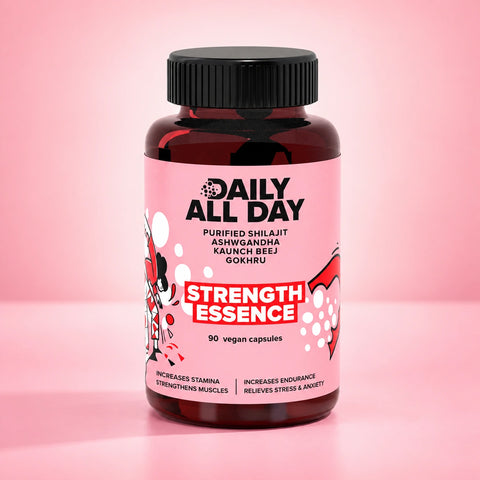
Quick Answer: Ashwagandha works by modulating the hypothalamic-pituitary-adrenal axis, lowering cortisol and calming the nervous system enough to support both reduced anxiety and deeper sleep. For ashwagandha for anxiety and sleep remote workers, Strength Essence- Energy and Stamina Booster delivers a clinically relevant dose alongside shilajit and kaunch beej.
Does Ashwagandha Help Anxiety and Sleep?
Table of Contents
- Why Remote Workers Keep Asking This Question
- The Cortisol-Sleep Cycle Nobody Talks About
- How Ashwagandha Fits a Real Bedtime Routine
- What the Ingredients Actually Do
- Finding the Right Formula
- Real Questions from Real People
- Frequently Asked Questions
- Where to Start Tonight
Why Remote Workers Keep Asking This Question
There's a particular kind of tired that doesn't improve with more coffee. You close the laptop, but the mental tab stays open. Your body is on the couch; your brain is still in the meeting. For a growing number of remote workers in their 30s and 40s, this gap between physical rest and genuine mental calm has become the defining friction of daily life.
Ashwagandha for anxiety and sleep remote workers has become one of the most searched wellness phrases in the US, and for good reason. A 2019 randomized controlled trial of 60 adults published in Medicine found that participants taking ashwagandha root extract reported significantly lower anxiety scores and meaningfully better sleep quality compared to the placebo group.[1] That result isn't a fluke, it replicated findings from earlier work.
Most articles you'll find cover the basics: cortisol drops, sleep improves, stress scores fall. What they skip is more useful: exactly who benefits most, what happens at the molecular level, and three practical things almost no guide mentions. We cover all three below.
The Cortisol-Sleep Cycle Nobody Talks About
Cortisol follows a natural arc. It peaks around 8 AM to help you wake up, then steadily declines toward bedtime, hitting its lowest point around midnight. Chronic stress, irregular schedules, and screen exposure collapse that arc. Cortisol stays elevated into the evening, and your brain never gets the biochemical signal that the day is over.
This is the specific problem ashwagandha addresses. Its primary active compounds, withanolides, interact with GABA receptors in a way that dials down nervous system arousal.[2] A 2012 study of 64 chronically stressed adults found that ashwagandha supplementation over 60 days produced a 27.9% reduction in serum cortisol levels, alongside measurable drops in perceived stress.[3] That's not a small effect for an over-the-counter herb.
Here's the gap most articles miss: ashwagandha doesn't sedate you. It doesn't force sleep the way melatonin nudges your circadian clock or the way antihistamines blunt your alertness. What it does is reduce the physiological noise (elevated cortisol, sympathetic nervous system activation) that prevents your body from falling asleep on its own. The sleep that follows tends to feel more natural and more restorative, not artificially heavy.
This distinction matters for remote workers especially. Many people who work from home report that their anxiety isn't one big stressor, it's a constant low hum. Background worry about deadlines, isolation, unclear work-life boundaries. Ashwagandha's adaptogenic mechanism suits that pattern well. It modulates the stress response system rather than suppressing it entirely, which means you can still function at full capacity during the day.
How Ashwagandha Fits a Real Bedtime Routine
Timing matters more than most people realize. Taking ashwagandha with or just after dinner, roughly 2 to 3 hours before bed, gives the root extract time to begin modulating cortisol during the window when it should naturally be declining. This is ashwagandha cortisol reduction bedtime in practice, not theory.
A natural night routine for stress relief built around ashwagandha might look like this:
- 7:30 PM: Take your ashwagandha dose with dinner or a small snack. Fat improves absorption of withanolides, so a meal helps.
- 8:00 PM: Dim overhead lights. Screens to night mode. This preserves what the ashwagandha is working to support: your body's natural melatonin curve.
- 8:30 PM: Light stretching or a short walk. Not intense exercise (which spikes cortisol), just enough movement to discharge physical tension from a desk-heavy day.
- 9:00 PM: A brief journal or brain dump. Write tomorrow's three priorities on paper. This closes mental loops and reduces rumination.
- 10:00 PM: Sleep environment at 65 to 68°F, dark, and phone charging outside the room.
This Ayurvedic sleep routine for Americans isn't complicated. It's consistent. And consistency is what makes the physiological adaptation stick. Our full guide on stress-free night routines goes deeper on each step if you want to build from here.
What the Ingredients Actually Do
Most coverage of ashwagandha focuses on the root extract alone. But the traditional Ayurvedic formulas that inspired modern supplements rarely used single herbs. There's a reason for that.
Ashwagandha (Withania somnifera)
The withanolides in ashwagandha are the primary active compounds. They interact with the HPA axis, reducing cortisol output and dampening the stress signal that keeps you wired at night. The standard clinically studied dose is 300mg to 600mg of root extract daily. Below 300mg, most studies show limited effect.
Shilajit
Shilajit is where many Western readers get skeptical, and understandably so. But its mechanism is specific: fulvic acid, the key active component, supports mitochondrial efficiency and CoQ10 production. For someone experiencing fatigue from chronic stress (a common companion to sleep disruption), this matters. Cellular energy production improves, and the crash-and-rebound pattern that drives afternoon anxiety becomes less pronounced. Learn more in our post on how remote workers benefit from these ingredients.
Kaunch Beej (Mucuna pruriens)
This is the ingredient almost no mainstream article mentions. Kaunch beej is a natural source of L-DOPA, the direct precursor to dopamine. Dopamine depletion from chronic stress contributes to low motivation, flat mood, and the particular kind of anxious restlessness that makes it hard to wind down at night. Replenishing L-DOPA precursors supports mood stability without stimulating the nervous system.
Omega-3 Fatty Acids
EPA and DHA reduce neuroinflammation. Chronic stress is inflammatory, and inflammation disrupts sleep architecture, specifically the deep, slow-wave sleep that handles physical recovery. Supporting omega status alongside adaptogenic herbs creates a more complete picture. Our overview of omega-3 rituals for remote workers covers the specifics.
Finding the Right Formula
For ashwagandha for anxiety and sleep remote workers, the formula needs to combine a meaningful ashwagandha dose with complementary ingredients. Single-herb capsules exist, but they often miss the synergistic picture.
Strength Essence- Energy and Stamina Booster combines ashwagandha root, shilajit, kaunch beej, and gokhru in a single daily formula. One capsule after breakfast supports daytime stress resilience. One capsule after dinner supports evening cortisol decline and sleep quality. The 90-capsule format covers a full 45-day trial, long enough to observe meaningful adaptation.
For the full anxiety and sleep picture, pairing Strength Essence with a cortisol-specific formula makes sense. Stress Free- Natural Stress Relief is built for that specific purpose. And if neuroinflammation or cognitive fog is part of your pattern, Total Wellness Omega 3-6-9 rounds out the support. We've written about this combination for overworked Americans specifically.
Two things worth knowing before you buy anything: ashwagandha is not recommended during pregnancy or breastfeeding, and it can interact with thyroid medications and immunosuppressants. If either applies to you, talk to your doctor first. Also, if you have a nightshade sensitivity (ashwagandha is in the Solanaceae family), start with a lower dose and monitor your response.
This second point is something almost none of the articles currently ranking on this topic address. Most list benefits without naming who should exercise caution. That's a real gap for readers making actual buying decisions. For desk workers dealing with joint-adjacent issues alongside stress, this guide on omega-3s for desk workers and this one for professionals before 40 cover the overlap.
What to Expect: 30, 60, and 90 Day Timeline
Day 30: Most people report falling asleep faster and waking fewer times during the night. Anxiety doesn't disappear, but the background hum feels quieter. Cortisol modulation begins within the first two to three weeks for many users, though the effect is subtle at first.
Day 60: Sleep architecture starts to shift. More time in deeper sleep stages, more consistent morning energy. The afternoon cortisol spike that drives 3 PM crashes tends to flatten. This is when the shilajit's mitochondrial support becomes more noticeable as sustained energy rather than peak-and-crash output.
Day 90: The HPA axis adaptation is more established by this point. Stress still happens, but the physiological response is proportionate rather than outsized. Most users in the 2012 study of 64 adults referenced above showed their strongest results at the 60-day mark, suggesting 90 days gives the full picture of what consistent use can do.
Real Questions from Real People
-
What actually reduces stress before bed?
- Dimming lights, a short movement break, and adaptogenic herbs timed with dinner are the three most evidence-supported tools.
- See what Quora users say about bedtime stress relief
-
Can omega-3s help with joint discomfort from desk work?
- EPA and DHA reduce inflammatory markers that contribute to joint aching from prolonged sitting. Plant-based sources provide a sustained effect.
- Quora: How can I use Omega-3 for joint pain?
-
Is melatonin the best option for sleep support?
- Synthetic melatonin nudges your sleep clock but doesn't address the elevated cortisol that keeps many people awake. Supporting natural melatonin production through light management and HPA-axis modulation often produces more durable results.
- Quora: Does melatonin help you get better sleep?
Frequently Asked Questions
Does ashwagandha actually reduce cortisol, or is that overstated?
It's not overstated, but context matters. A 2012 randomized trial of 64 chronically stressed adults found a 27.9% reduction in serum cortisol after 60 days of 300mg ashwagandha root extract twice daily. That's a statistically significant drop in a population with baseline elevated cortisol. The effect is most pronounced in people with genuinely high stress loads, not in people whose cortisol is already in normal range.
Is ashwagandha for anxiety and sleep safe to take every day long-term?
Most clinical trials run for 8 to 12 weeks with no adverse effects reported beyond occasional mild GI discomfort in sensitive individuals. Long-term daily use beyond 12 weeks hasn't been studied as extensively, so periodic breaks (one week off per month, for example) are a reasonable precaution. If you're on thyroid medication or immunosuppressants, check with your doctor before starting.
What time of day should remote workers take ashwagandha for sleep benefits?
Taking ashwagandha with dinner, roughly 2 to 3 hours before bed, aligns the herb's cortisol-modulating effect with the window when cortisol should naturally be declining. Some formulas split the dose: one capsule with breakfast to support daytime stress resilience, one with dinner to support evening wind-down. Both approaches have clinical backing.
Can ashwagandha help with anxiety that isn't sleep-related?
Yes. The HPA-axis modulation that makes ashwagandha useful for sleep also reduces daytime anxiety scores. A 2019 trial of 60 adults found significant reductions on the Hamilton Anxiety Rating Scale after 60 days of root extract supplementation. The effect appears to be on the baseline stress response, not just the nighttime symptom.
Who shouldn't take ashwagandha?
People who are pregnant or breastfeeding should avoid it. People with autoimmune conditions (lupus, rheumatoid arthritis, multiple sclerosis) should consult a doctor first because ashwagandha can stimulate immune activity. Those with thyroid conditions or on related medications should also get medical guidance, as ashwagandha may influence thyroid hormone levels.
How is ashwagandha different from just taking a sleep supplement with melatonin?
Melatonin shifts your sleep timing. It's useful for jet lag and shift work. Ashwagandha addresses the upstream problem: why your cortisol is too high to let you sleep in the first place. The two can complement each other, but for remote workers whose issue is stress-driven wakefulness rather than circadian misalignment, ashwagandha targets the actual bottleneck.
Where to Start Tonight
The case for ashwagandha for anxiety and sleep remote workers isn't built on tradition alone. The cortisol data is real. The sleep quality improvements in controlled trials are real. What's missing from most coverage is the practical layer: right dose, right timing, right formula, and an honest picture of who should be cautious.
If your nights feel like your workday never quite ended, the Ayurvedic sleep routine for Americans described here is a reasonable starting point. Begin with the timing and light protocol tonight. Add supplemental support once you've locked in the behavioral foundation. Give it 30 days before judging results.
For the full ingredient breakdown and dosing details:
See the full Strength Essence formula and how it fits this routine