Does Ashwagandha Really Relieve Anxiety and Stress?
Share

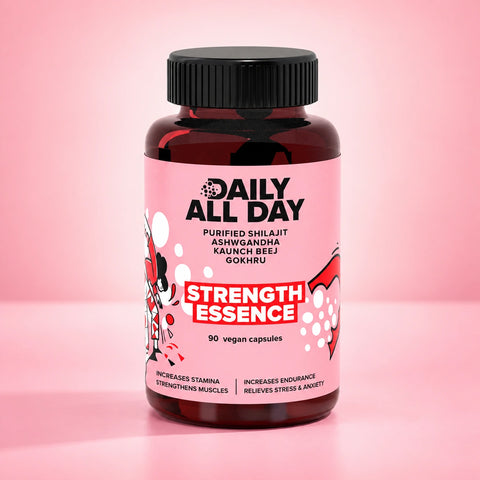
Quick Answer: Ashwagandha works for anxiety and stress relief by lowering serum cortisol and modulating the HPA axis, the body's central stress-response system. Strength Essence- Energy and Stamina Booster pairs ashwagandha root extract with shilajit and kaunch beej for compounded, sustained calm without sedation.
Does Ashwagandha Really Relieve Anxiety and Stress?
Table of Contents
- The Stress Pattern No One Talks About
- What Cortisol Is Actually Doing to You
- Foods and Habits That Keep Cortisol High
- Ashwagandha for Anxiety and Stress Relief: The Science
- How Strength Essence Fits This Picture
- Day-to-Day Habits That Multiply the Effect
- Real Questions, Straight Answers
- Frequently Asked Questions
The Stress Pattern No One Talks About
Most articles on ashwagandha open with a cortisol graph or a statistic about burnout. Here's something more useful: a pattern.
You wake up already slightly anxious. Coffee sharpens it. By 2 p.m. your focus dissolves. By 9 p.m. you're wired but tired, staring at your phone, unable to wind down. That cycle, repeated five days a week, is what chronic low-grade stress actually looks like. Not a dramatic breakdown. Just a slow grind on your nervous system.
Ashwagandha for anxiety and stress relief is relevant here because the herb doesn't sedate you or spike your energy. It works on the underlying hormonal loop that keeps that cycle running. That distinction matters, and it's one most competing articles skip over entirely.
What Cortisol Is Actually Doing to You
Cortisol is your body's primary stress hormone, released by the adrenal glands in response to signals from the hypothalamic-pituitary-adrenal (HPA) axis. In short bursts, it's useful. It sharpens alertness, mobilizes energy, keeps you functional under pressure.
The problem is chronic activation. When the HPA axis stays partially switched on, cortisol doesn't return to baseline the way it should. Sleep quality drops. Mood becomes less stable. Cognitive sharpness dulls. A 2019 double-blind trial of 144 adults found that participants taking ashwagandha root extract showed a statistically significant reduction in serum cortisol compared to placebo after 60 days.[1]
For remote workers especially, the absence of a physical commute, set break times, or environmental cues that signal "day is over" keeps this stress loop running longer than it would in a traditional office setting. If your workspace and your couch occupy the same room, your nervous system never fully shifts gears. We've found this to be one of the most underreported contributors to anxiety in the 25-45 age group.
For a deeper look at how sustained cortisol affects body composition and energy levels, our cortisol, belly fat, and burnout guide covers the downstream effects in detail.
Foods and Habits That Keep Cortisol High
Supplementation works better when you're not actively refueling the stress loop. A few common habits that blunt ashwagandha's effects:
- Excess caffeine after noon: Caffeine extends cortisol elevation. Three cups before noon is very different from three cups spread across the day.
- Skipping meals during busy sprints: Blood sugar dips are a physiological stressor. Your adrenals respond the same way they would to an emotional threat.
- Ultra-processed snack patterns: High glycemic foods cause cortisol spikes through rapid blood sugar swings.
- Chronic under-sleeping: Even one night of poor sleep raises cortisol the following day, compounding over time.
On the other side: magnesium-rich foods (pumpkin seeds, dark leafy greens), complex carbs timed around physical movement, and consistent meal windows all support the HPA axis in ways that complement adaptogens.
Ashwagandha for Anxiety and Stress Relief: The Science
Ashwagandha (Withania somnifera) contains a class of bioactive compounds called withanolides. These steroidal lactones interact with the HPA axis, GABAergic receptors, and inflammatory pathways that all play a role in anxiety and stress response.
The clinical record is reasonably strong. A 2021 randomized controlled trial of 60 adults found that 240 mg of ashwagandha extract daily reduced self-reported anxiety scores and morning cortisol levels significantly versus placebo after eight weeks.[2] A separate 2022 study of 80 working adults reported improvements in both perceived stress and sleep onset after 300 mg twice daily for eight weeks.[3]
Three things that most articles on ashwagandha for anxiety and stress relief don't cover clearly:
1. Timing relative to meals matters more than most people realize. Ashwagandha's fat-soluble withanolides absorb better when taken with food, particularly meals that contain some dietary fat. Taking it on an empty stomach is not dangerous, but absorption is likely suboptimal. Morning with breakfast or evening with dinner tends to work well for most users.
2. Who should not take it. Ashwagandha is not appropriate for everyone. People who are pregnant or breastfeeding are generally advised to avoid it. Those with autoimmune conditions (such as Hashimoto's thyroiditis or rheumatoid arthritis) should talk to a healthcare provider first, because ashwagandha can modulate immune activity. People on thyroid medication should also check in with their doctor, as the herb may affect thyroid hormone levels. None of the top-ranking articles on this topic list these groups specifically, and readers deserve that clarity.
3. Six to eight weeks is the minimum window for meaningful results. The studies that show cortisol reduction consistently run six to eight weeks. If you try ashwagandha for ten days and feel nothing, that's expected. This is an adaptogen, not a fast-acting anxiolytic. Consistent daily use over time is how it works.
For a broader look at how ashwagandha fits into an adaptogen stack, our ashwagandha adaptogen routine guide outlines a practical daily approach.
How Strength Essence Fits This Picture
Strength Essence- Energy and Stamina Booster combines ashwagandha root extract with two complementary Ayurvedic ingredients: shilajit and kaunch beej.
Shilajit is a mineral-rich resin traditionally used for cellular energy and stamina. Its primary active compound, fulvic acid, is thought to support mitochondrial function, which is relevant when stress-related fatigue is the main complaint rather than pure anxiety. Kaunch beej (Mucuna pruriens) contains L-DOPA, a precursor to dopamine, and has been studied for its role in mood stability and motivation in small clinical studies.[4]
The combination addresses two distinct but related problems: the anxious edge that ashwagandha targets through cortisol modulation, and the flat, depleted feeling that often follows weeks of chronic stress. Many single-ingredient ashwagandha supplements miss the second half of that equation.
If physical tension or joint stiffness from long sitting sessions is also part of your picture, our Joint Care formula and desk job mobility guide are worth a read alongside this. And for targeted cortisol support, the Stress Free supplement is another option in our lineup.
30/60/90 Day Timeline
Days 1-30: The most common early reports are slightly better sleep quality and less afternoon energy collapse. Some people notice a quieter mental baseline within two to three weeks. Don't expect dramatic changes yet. The HPA axis adapts slowly.
Days 30-60: Cortisol modulation becomes more consistent. Morning anxiety, if that was a starting symptom, tends to soften. Focus during cognitively demanding work often improves. This is the window where most clinical trials begin showing measurable cortisol differences.
Days 60-90: For most consistent users, this is where the cumulative effect becomes noticeable in daily life, not just on a symptom checklist. Stress response feels more proportionate. Recovery after a difficult day happens faster. Sleep architecture often improves. These are the outcomes the eight-week trials were capturing at their endpoints.
For more on sustaining energy through demanding work schedules, the energy support guide for overworked Americans covers complementary strategies in depth.
Day-to-Day Habits That Multiply the Effect
Ashwagandha for anxiety and stress relief works best as part of a consistent routine, not as a standalone fix. A few high-leverage habits:
- Morning light before screens: Natural light within 30 minutes of waking helps anchor your circadian rhythm, which in turn stabilizes cortisol's natural morning peak.
- Movement breaks every 90 minutes: Brief walks or stretching interrupts the cortisol accumulation that comes from sustained sedentary focus. It doesn't need to be a workout.
- A firm stop time: Particularly for remote workers, a consistent end-of-workday ritual, even a short one, helps the nervous system register the shift. Your HPA axis responds to behavioral cues.
- Consistent sleep and wake times: Cortisol follows a circadian rhythm. Irregular sleep schedules disrupt that rhythm, reducing the benefit of any adaptogen.
For more detailed cortisol reset strategies, the cortisol spike reset guide outlines a practical daily sequence.
Real Questions, Straight Answers
Q: Is ashwagandha actually useful for anxiety, or just stress?
Both, with some nuance. The clinical evidence is stronger for perceived stress and cortisol reduction than for clinical anxiety disorders. For mild to moderate anxiety rooted in chronic stress, the mechanism overlaps significantly. Ashwagandha is not a replacement for mental health care in cases of severe anxiety.
Q: What are the best ways to lower cortisol quickly?
Acute cortisol spikes respond fastest to physical movement, slow breathing, and removing the stressor where possible. Ashwagandha works on the chronic pattern, not the acute spike. Community perspectives on fast cortisol reduction are worth reading alongside the clinical data.
Q: Can I take ashwagandha with coffee?
Generally yes, though if caffeine sensitivity is high, stacking them may feel overstimulating for some people. Taking ashwagandha with a meal that contains fat, separately from your morning coffee, sidesteps any interaction concern and supports better absorption.
Frequently Asked Questions
Does ashwagandha actually lower cortisol, or is that marketing?
The cortisol claim is backed by clinical data, not just marketing. A 2019 double-blind trial of 144 adults found statistically significant reductions in serum cortisol in the ashwagandha group compared to placebo after 60 days. The mechanism involves modulation of the HPA axis, the hormonal system that regulates how much cortisol your body produces in response to stress. The effect is real but gradual, typically measurable after six to eight weeks of consistent use.
Who should avoid taking ashwagandha?
Pregnant and breastfeeding individuals are generally advised to avoid ashwagandha due to insufficient safety data and some evidence of uterine-stimulating effects. People with autoimmune conditions, including Hashimoto's thyroiditis, lupus, or rheumatoid arthritis, should consult a healthcare provider before use, because ashwagandha can modulate immune activity. Those on thyroid hormone medications should also check in with their doctor, as the herb may influence thyroid levels. This group is rarely named in mainstream articles on the topic.
Does timing matter for ashwagandha? Morning or night?
Timing does matter, and it's more nuanced than most guides acknowledge. Because ashwagandha's withanolides are fat-soluble, taking the supplement with a meal that contains dietary fat improves absorption. For people whose primary complaint is anxiety or daytime stress, morning with breakfast is a common starting point. If sleep quality is the bigger concern, evening with dinner may be more appropriate. Both are valid; consistency matters more than the specific window.
How is Strength Essence different from a plain ashwagandha capsule?
Plain ashwagandha targets cortisol and HPA axis modulation. Strength Essence- Energy and Stamina Booster adds shilajit, which supports cellular energy through fulvic acid, and kaunch beej, which provides L-DOPA as a dopamine precursor for mood and motivation. This addresses the full stress-fatigue picture: not just the anxious edge, but the depleted, flat feeling that often follows weeks of chronic stress.
How long does ashwagandha for anxiety and stress relief take to work?
Clinical trials consistently show meaningful results at six to eight weeks of daily use at 300–600 mg. Some users notice subtle improvements in sleep or afternoon energy within two to three weeks, but significant cortisol normalization takes longer. Expecting results in under two weeks sets up early disappointment. The 30/60/90 day framework in this article reflects what the published trial data actually shows at each checkpoint.
Can ashwagandha help with work-from-home burnout specifically?
The mechanisms are directly relevant. Remote work tends to produce chronic, low-level HPA axis activation because environmental cues that normally signal "work is over" are absent. Ashwagandha's cortisol-modulating properties address exactly this pattern of sustained, low-grade stress, rather than acute situational anxiety. Pairing it with behavioral anchors like consistent stop times and morning light exposure, as outlined in this article, amplifies the effect.
The evidence for ashwagandha for anxiety and stress relief is genuinely solid, particularly for the kind of chronic, low-grade stress that remote work and always-on schedules produce. The key is giving it enough time, pairing it with meals for absorption, and knowing upfront that it's not a quick fix but a cumulative one. Strength Essence adds the energy and mood support that a standalone ashwagandha supplement often misses, making it a more complete option for people dealing with both the anxious edge and the burnout fatigue underneath it.
See the full Strength Essence- Energy and Stamina Booster formula →