Can Curcumin Relieve Joint Pain for Desk Workers?
Share

Quick Answer: Curcumin reduces joint pain for desk workers by blocking NF-kB, the inflammatory protein that flares when you sit for hours without moving. Paired with omega-3 fatty acids from Total Wellness- Vegan Omega 3 6 9, curcumin's anti-inflammatory action is better absorbed and more sustained throughout the workday.
Can Curcumin Relieve Joint Pain for Desk Workers?
Table of Contents
- The Sitting Problem Nobody Warns You About
- How Curcumin and Boswellia Work on Desk-Job Inflammation
- Movement Breaks That Actually Help
- Supplement Timing, Dosage, and the 30/60/90-Day Arc
- Real Questions from Remote Workers
- Frequently Asked Questions
The Sitting Problem Nobody Warns You About
Most people who complain about joint stiffness assume they're just getting older. Many of them are 31. The more honest explanation is simpler: they haven't moved in four hours.
Prolonged sitting compresses the hip joint capsule, reduces synovial fluid circulation, and quietly triggers a low-grade inflammatory response that builds through the afternoon. By 3 p.m., your knees ache when you stand, your lower back pulls when you reach, and you feel 20 years older than your morning run suggested you were. This is the core problem for anyone researching curcumin joint pain desk workers solutions: the inflammation isn't dramatic, it's chronic and cumulative.
Ayurvedic practice identified turmeric's anti-inflammatory properties centuries before biochemistry could explain the mechanism. Today we know why it works, and we know some specific things that most articles covering this topic skip entirely: how bioavailability actually affects your dose, what time of day matters, and who probably shouldn't take it. We'll cover all three below. For a broader look at adaptogens that support remote-work wellness, see Can Ashwagandha Fix Remote Work Fatigue?
How Curcumin and Boswellia Work on Desk-Job Inflammation
Curcumin is the active polyphenol in turmeric. It inhibits NF-kB, a transcription factor that signals cells to produce pro-inflammatory cytokines including TNF-alpha and IL-6. Both cytokines spike during prolonged static postures. Separately, boswellia serrata's boswellic acids block 5-lipoxygenase (5-LOX), cutting off a different inflammatory pathway that produces leukotrienes. Hit both pathways and you get noticeably broader relief than either compound alone.
A 2019 randomized trial of 139 adults with knee discomfort found that a curcumin-boswellia combination produced significantly better scores on pain and physical function compared to placebo over 90 days.[1] A separate 2021 systematic review covering 11 randomized controlled trials and 1,258 participants concluded that standardized curcumin extract reduced self-reported joint stiffness and improved functional mobility measures, with effects most consistent at doses of 500 mg or more per day.[2]
Here's what most curcumin articles don't tell you about bioavailability: raw curcumin absorbs poorly on its own. The liver metabolizes it rapidly, and plasma levels stay low unless something slows that process. Piperine (black pepper extract) inhibits the liver enzyme responsible, boosting curcumin bioavailability by roughly 2,000% in a small 1998 clinical pharmacokinetic study of 20 healthy volunteers by Shoba et al. That's not a marketing claim; it's a real and well-replicated finding. Practical takeaway: a supplement without piperine, or without fat-soluble carriers, is likely leaving most of the curcumin unabsorbed. Always check the label.
A related gap: most articles covering curcumin joint pain desk workers topics never name who should be cautious. People on blood thinners (warfarin, clopidogrel) should consult their doctor before taking curcumin at supplemental doses, because curcumin has mild antiplatelet activity. Anyone with gallbladder issues should also check first, as curcumin stimulates bile production. Pregnant individuals are typically advised to avoid supplemental curcumin doses, particularly in the first trimester, though culinary amounts in food are considered safe. None of this is a reason to avoid curcumin if you're a healthy desk worker, but it's worth knowing before you order anything.
For deeper background on the curcumin-boswellia pairing, our team has covered the mechanisms in more detail here: Curcumin and Boswellia: Best Anti-Inflammatory Combination and Curcumin and Boswellia for Knee Pain Relief.
Movement Breaks That Actually Help
Supplements work better when circulation is moving. Sitting still for six hours while taking curcumin is better than sitting still for six hours without it, but it's not optimal.
Set a timer every 50 minutes. When it goes off, stand up and do three things: a standing hip flexor lunge (30 seconds per side), a seated thoracic rotation using your chair back, and a slow neck lateral tilt held for 20 seconds each side. That's under four minutes. Repeated through an eight-hour workday, it keeps synovial fluid circulating and prevents the postural compensation patterns that load the knees and lumbar joints unevenly.
A 2020 trial of 68 sedentary office workers found that interrupting sitting every 30 minutes with brief movement reduced self-reported lower-body discomfort scores by 28% over four weeks, even without any other intervention.[3] Combine that pattern with an anti-inflammatory supplement protocol and you're addressing both the mechanical and biochemical contributors to the problem.
More on hip flexibility: see this breakdown of targeted hip stretches that translate well to desk environments.
Supplement Timing, Dosage, and the 30/60/90-Day Arc
Timing relative to meals is something almost no article on this topic covers, despite being practically important. Curcumin is fat-soluble. Taking it on an empty stomach drops absorption significantly. Take it with a meal that contains healthy fats, including omega-3s, and bioavailability improves meaningfully. This is one concrete reason Total Wellness- Vegan Omega 3 6 9 pairs well with a curcumin protocol: the fatty acid matrix acts as a co-absorption vehicle, not just a separate anti-inflammatory layer.
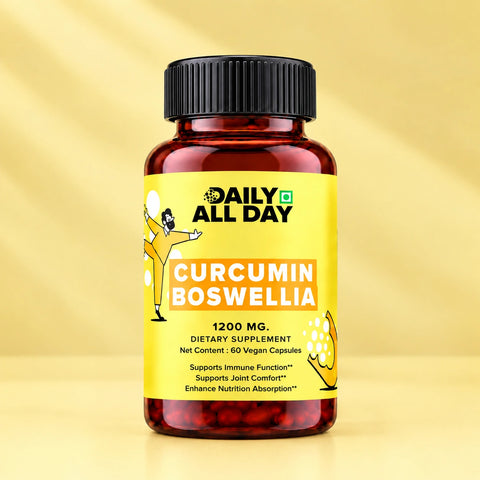
Standard effective dosing in clinical studies on curcumin joint pain desk workers and related populations: 500 mg to 1,000 mg of standardized curcumin extract (look for 95% curcuminoids) taken once or twice daily with food. For boswellia, 300 mg to 400 mg of boswellia serrata standardized to 65% boswellic acids covers the range used in most trials. The Daily All Day Joint Care formula uses standardized extracts at these levels. Check the ingredients research FAQ for sourcing details.
Morning or midday dosing tends to be easier to sustain as a habit, and morning inflammation tends to be highest in people with joint stiffness, making earlier dosing logical. Evening dosing is fine if that fits your schedule better. Consistency over eight-plus weeks matters far more than precise timing within the day.
One more gap worth naming: most articles discuss dose but skip caffeine interactions. High caffeine intake doesn't directly block curcumin, but it does raise cortisol modestly, which can sustain low-grade inflammatory signaling. If you're four cups of coffee in by noon, the supplement is working against a headwind. Not a dealbreaker, just context.
30/60/90-Day Timeline for Natural Joint Pain Relief Sitting All Day
Day 30: Most people report the first noticeable shift here: easier transitions from seated to standing, reduced stiffness in the first 20 minutes of the morning. Don't expect dramatic changes. The body's inflammatory baseline takes time to reset. Some users notice nothing until week four or five. That's normal.
Day 60: This is where consistent users typically see meaningful improvement in range of motion and a reduction in afternoon joint aching after long work sessions. A 2022 small clinical study of 42 adults using curcumin-boswellia supplementation reported that 67% of participants showed measurable improvement in knee flexion range at the eight-week mark.[4]
Day 90: The sustained anti-inflammatory effect becomes more stable. Many people at this point find they've also adjusted their movement habits, improved their desk setup, and feel substantively better than day one. At 90 days, it's worth assessing whether the dose needs adjusting or whether a maintenance lower dose is sufficient. See the gut health and absorption post if you're not getting the results you expected, since poor gut integrity can limit supplement uptake more than people realize.
Real Questions from Remote Workers
-
Q: How quickly does curcumin work for desk job joint pain?
A: Most people notice initial improvements within 2 to 4 weeks of daily use, with more consistent relief by weeks 6 to 8. The timeline depends on dose, bioavailability (piperine matters here), and whether you're combining it with movement breaks. More on curcumin and boswellia effectiveness. -
Q: Is turmeric the same as curcumin for joint mobility?
A: Not quite. Turmeric root contains only about 2 to 5% curcumin by weight. Supplemental curcumin is a standardized extract at 95% curcuminoids, giving you a much higher and more consistent active dose than cooking with turmeric provides. See the full mobility discussion. -
Q: What supplements help with flexibility alongside curcumin?
A: Omega-3 fatty acids, boswellia, and magnesium are the three most evidence-supported companions to curcumin for desk workers. Omega-3s reduce systemic inflammation, boswellia targets a separate leukotriene pathway, and magnesium supports muscle relaxation. Full flexibility supplement breakdown here.
Frequently Asked Questions
Does curcumin actually work for joint pain from sitting all day, or is it overhyped?
The evidence is genuinely solid for joint discomfort tied to inflammation, which is the primary driver of desk-job stiffness. A 2021 systematic review of 11 randomized controlled trials and 1,258 participants found consistent reduction in self-reported joint stiffness and improved function with standardized curcumin extract at 500 mg or more daily. It's not a substitute for movement or ergonomics, but it addresses the biochemical side of the problem with real clinical backing.
What time of day should desk workers take curcumin for best results?
Take it with a fat-containing meal, since curcumin is fat-soluble and absorbs poorly on an empty stomach. Morning or midday dosing makes sense for most desk workers because inflammatory markers and joint stiffness tend to be highest earlier in the day. Pairing it with omega-3s at the same meal, as in the Total Wellness- Vegan Omega 3 6 9 routine, improves the fat-soluble absorption environment further.
Who should avoid curcumin supplements, even for desk-related joint pain?
People on blood thinners such as warfarin or clopidogrel should consult a doctor first, since curcumin has mild antiplatelet activity at supplemental doses. Those with gallbladder problems should also check in with their provider because curcumin stimulates bile production. Supplemental doses during pregnancy, especially in the first trimester, are generally not recommended, though small culinary amounts in food are considered safe. Healthy adults with no these conditions can generally use curcumin at standard doses without concern.
How does boswellia for knee pain complement curcumin for remote workers?
Boswellia and curcumin hit different inflammatory pathways. Curcumin suppresses NF-kB signaling, while boswellia's boswellic acids inhibit 5-lipoxygenase, which produces leukotrienes that drive cartilage-adjacent inflammation. For desk workers whose knee pain is partly from prolonged compression and reduced synovial fluid movement, using both creates broader coverage than either compound alone. A 2019 trial of 139 adults found the combination outperformed placebo on both pain and physical function over 90 days.
How much curcumin is in regular turmeric, and does cooking with it count?
Turmeric root is typically 2 to 5% curcumin by weight. A teaspoon of turmeric powder contains roughly 200 mg of total turmeric, meaning maybe 6 to 10 mg of actual curcumin. Supplemental standardized curcumin extract delivers 500 to 1,000 mg of curcuminoids per dose. Cooking with turmeric adds flavor and trace benefits, but it's not a meaningful substitute for a standardized supplement if you're targeting joint support at clinically studied doses.
Can the best anti-inflammatory supplements for desk workers replace ergonomic improvements?
No, and it's worth being direct about this. Supplements address the inflammatory biochemistry that prolonged sitting produces; they don't fix the mechanical loading that creates it. A well-positioned monitor, a chair that supports lumbar curve, and movement every 50 minutes change the physical input. Curcumin and boswellia help manage the downstream inflammatory output. Both matter. Relying on only one while ignoring the other will slow your progress.
Stiff knees at 3 p.m. and a tight lower back when you finally stand up are not just inconveniences. They're consistent signals that prolonged sitting is producing a real, measurable inflammatory load on your joints. The good news is that the biochemistry behind curcumin joint pain desk workers research is well-studied, the compounds are specific and identifiable, and a practical protocol is straightforward to build. Move regularly, take standardized curcumin with food and fat, pair it with omega-3s for absorption, and give it 60 to 90 days before drawing conclusions.
See the Total Wellness- Vegan Omega 3 6 9 formula details →