Smoothies vs Meals: Ayurvedic Energy Fix
Share

Quick Answer: When comparing ayurvedic energy supplements vs smoothies for daily energy, supplements like Strength Essence- Energy and Stamina Booster offer a distinct edge — Ashwagandha reduces cortisol and supports sustained stamina, while Shilajit enhances cellular energy production at the mitochondrial level. Smoothies deliver fast micronutrients but can spike blood sugar without protein or fat balance, whereas Ayurvedic adaptogens work steadily in the background to keep your energy consistent all day.
Smoothies vs Meals: Ayurvedic Energy Fix — ayurvedic energy supplements vs smoothies for daily energy
Introduction & The Energy Dilemma
It's 8 AM on a Tuesday. You're logging into your third Zoom call before you've even finished your coffee. Sound familiar? For millions of American remote workers, freelancers, and health-conscious adults juggling hybrid schedules, daily energy management is a real, practical challenge — not just a wellness buzzword.
The question of ayurvedic energy supplements vs smoothies for daily energy comes up constantly in wellness communities, Quora threads, and nutrition circles. Both promise sustained focus and vitality. But how do they actually stack up against each other — and could the smarter answer be combining the best of both worlds? Many people reach for quick fixes like bloom energy drinks, but the real solution runs deeper than caffeine spikes and sugar crashes.
Let's break this down with nutrition science, Ayurvedic wisdom, and practical guidance built for your real daily routine.
Smoothies vs. Whole Meals: Overview
What Makes a Smoothie?
- Blended fruits, leafy greens, dairy or plant-based milk
- Optional add-ins: protein powder, nut butter, chia seeds, oats
- Highly customizable — can lean high-sugar or high-protein depending on ingredients
- Fast to prepare, easy to consume on the go
What Counts as a Whole Meal?
- Balanced plates: brown rice + lentils + roasted vegetables, grain bowls, home-cooked proteins with fiber-rich sides
- Contains all macronutrients — protein, complex carbs, healthy fats — plus dietary fiber
- Requires chewing, which triggers satiety hormones and slows digestion
Why Does This Matter for Your Energy?
The smoothie nutritional value vs full meal debate isn't just about calories. It's about how your body accesses and sustains energy throughout the day. Blood sugar stability, fiber content, digestion speed, and micronutrient density all play a role — and that's exactly where Ayurvedic thinking adds value that neither option fully delivers on its own.
Energy, Benefits, and Drawbacks
Smoothies: What They Do Well (and Where They Fall Short)
-
Pros:
- Rapid micronutrient delivery — vitamins, minerals, and antioxidants absorbed quickly
- Ideal for low-appetite mornings or post-workout recovery
- Easy to add fiber, protein, and healthy fats with the right ingredients
- Portable and prep-friendly for busy remote work schedules
-
Cons:
- Blending breaks down fiber structure, potentially spiking blood sugar faster than whole fruit
- Liquid calories are less satiating — you may feel hungry within 90 minutes
- Easy to overload on natural sugars without realizing it
- Missing the "chewing effect" that stimulates digestive enzymes and fullness signals
Whole Meals: The Long-Game Advantage
-
Pros:
- Complex carbohydrates provide slow, steady glucose release — no energy crash mid-afternoon
- Higher satiety due to fiber, protein, and the mechanical act of chewing
- Broader nutrient variety supports brain function, hormonal balance, and immune health
- Better for whole food energy vs blended meal remote workers who need focus for hours at a time
-
Cons:
- Time-consuming to prepare and eat
- Heavier meals can cause post-lunch sluggishness if not balanced properly
What the Research Shows
Reducing ultra-processed food intake — in both smoothies and meals — is linked to improved metabolic health markers and lower risk of chronic metabolic conditions.[1] Micronutrients including magnesium, zinc, B6, iron, and vitamin D — found naturally in whole foods — are essential for neurological function and sustained physical energy throughout the day.[2] Plant-based whole food sources rich in protein and fiber deliver more stable, longer-lasting energy compared to high-sugar liquid meals.[3]
Ingredients Deep Dive
Smoothie Nutritional Value vs Full Meal: Side-by-Side
| Nutrient Category | Typical Smoothie | Typical Whole Meal |
|---|---|---|
| Fiber | Moderate (broken down by blending) | High (intact cell walls) |
| Protein | Variable (add-in dependent) | High (meat, legumes, dairy) |
| Micronutrients | High (fruits, greens) | Very high (diverse ingredients) |
| Blood Sugar Impact | Moderate-High (fruit-heavy) | Low-Moderate (complex carbs) |
| Satiety Duration | 1.5–2.5 hours | 3–5 hours |
Whole foods provide micronutrients like magnesium, zinc, iron, and B-vitamins that support sustained brain and muscle energy throughout the day.[4] Understanding daily carbohydrate and protein needs for US adults can help you build meals that fuel you without the afternoon crash.
Where Ayurvedic Supplements Fill the Gap
Here's the honest truth: even the most carefully crafted smoothie or balanced whole meal won't fully address adaptogenic stress resilience, mitochondrial energy support, or the kind of deep fatigue that comes from chronic overwork. That's where the comparison of ayurvedic energy supplements vs smoothies for daily energy becomes especially relevant for remote workers and busy professionals.
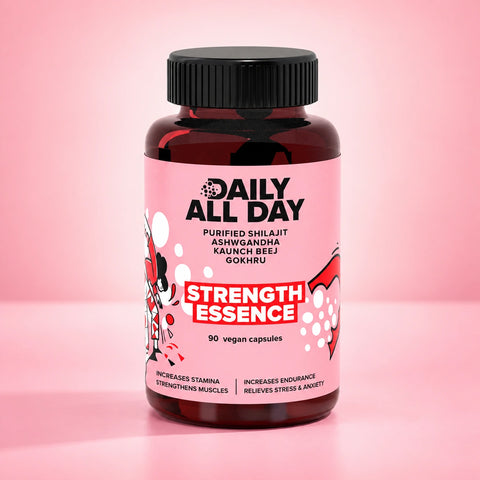
The Strength Essence- Energy and Stamina Booster by Daily All Day combines time-tested Ayurvedic herbs with modern supplement science:
- Ashwagandha (Withania somnifera): A clinically studied adaptogen that helps regulate cortisol — the stress hormone that drains your energy reserves when chronically elevated. Supports stamina, mental clarity, and physical endurance.
- Shilajit: A mineral-rich resin that enhances mitochondrial function, improving how efficiently your cells produce ATP — the body's core energy currency.
- Kaunch Beej (Mucuna pruriens): A natural source of L-DOPA, supporting dopamine pathways that regulate motivation, mood, and mental drive.
- Gokhru (Tribulus terrestris): Supports physical stamina, muscle recovery, and helps reduce fatigue after exertion.
For complete daily nutrition, the Ayurvedic Multivitamin with B12 & B-Complex covers 23 vitamins and minerals — including the B-vitamins that convert food into usable energy at the cellular level.
Quora Q&A Insights
Real people ask real questions. Here's what the wellness community is actually discussing:
- Which is better — a smoothie diet or a whole food diet? — Community consensus: whole food diets win for long-term satiety and nutrient variety, but smoothies excel for convenience and quick nutrition.
- Is it better to blend a smoothie than eat whole fruits and vegetables? — Answer: Whole fruits preserve more fiber structure, but blended smoothies are far better than skipping breakfast entirely.
- Which meal is best to replace with a smoothie? — Breakfast is the most popular swap, especially for those with low morning appetite or tight schedules.
- Can smoothies be a good meal replacement? — Yes — if balanced with protein, healthy fat, and fiber. A fruit-only smoothie won't cut it for sustained energy.
- Which is better — eating fruit or drinking a smoothie? — Both have merit. Whole fruit preserves fiber integrity; smoothies make it easier to consume more variety at once.
The common thread? Neither approach is perfect alone — and that's exactly why whole food energy vs blended meal remote workers discussions so often end with the same conclusion: strategy matters more than format.
Supplement Support for Daily Energy
Whether you're a smoothie person, a whole-meal planner, or somewhere in between, targeted supplementation fills the nutritional gaps that diet alone often misses. This is the core insight when evaluating ayurvedic energy supplements vs smoothies for daily energy — they're not competitors. They're teammates.
If you've been wondering why Americans feel persistently tired despite eating well, adaptogenic herbs like Ashwagandha and Shilajit address root causes — hormonal stress response and cellular energy efficiency — that food alone can't easily reach.
And if you're active, live in a hot climate, or sweat heavily, you may also be losing electrolytes that tank your energy — read more about energy loss in hot climates and potassium needs. Gut health is another often-overlooked energy drain — explore probiotics for gut health to see how digestion impacts your daily vitality.
How to Use Strength Essence- Energy and Stamina Booster
- Dosage: 1 capsule twice daily, taken after meals
- Best taken with: Water, after breakfast and dinner
- Stack with: A protein-rich smoothie in the morning and a balanced whole meal at lunch for comprehensive energy support
- Who should avoid: Pregnant or nursing individuals, or anyone with known allergies to listed botanical ingredients — consult your healthcare provider first
30 / 60 / 90 Day Energy Timeline
Days 1–30 (Foundation Phase): Your body begins adapting to the adaptogenic compounds. Many users notice improved sleep quality, slightly reduced afternoon fatigue, and better stress resilience within the first two to three weeks. Smoothies and whole meals are supporting your baseline nutrition during this phase.
Days 31–60 (Building Phase): Ashwagandha and Shilajit begin showing more consistent effects. Users typically report steadier energy throughout the workday, reduced reliance on afternoon caffeine, and improved physical endurance. This is when the best ayurvedic multivitamin USA pairing with your diet becomes most noticeable.
Days 61–90 (Optimization Phase): With consistent daily use alongside balanced meals or well-structured smoothies, most users experience sustained stamina, sharper mental focus, and a noticeably more even energy curve from morning through evening. The combination of whole food energy vs blended meal strategies — with Ayurvedic support — reaches its full rhythm.
Try Strength Essence- Energy and Stamina Booster →Frequently Asked Questions
What does comparing ayurvedic energy supplements vs smoothies for daily energy actually mean?
It's a practical framework for choosing how to fuel your day. Smoothies deliver rapid micronutrients through blended whole foods — great for mornings but potentially short on staying power. Ayurvedic supplements like Strength Essence- Energy and Stamina Booster work at the hormonal and cellular level — regulating cortisol via Ashwagandha and enhancing ATP production via Shilajit — providing a layer of energy support that food simply cannot replicate. The smartest approach uses both: smoothies and whole meals for macronutrient fuel, Ayurvedic supplements for deep, adaptogenic resilience.
How does Strength Essence- Energy and Stamina Booster support energy differently than food?
Food provides calories, vitamins, and minerals — the raw materials for energy. Strength Essence- Energy and Stamina Booster works on the regulatory systems that determine how efficiently your body uses those raw materials. Ashwagandha reduces cortisol-driven energy drain, Shilajit supports mitochondrial efficiency (how well your cells convert nutrients into usable energy), and Kaunch Beej supports the dopamine pathways that keep you motivated and mentally sharp. It's not a food substitute — it's an energy multiplier.
How long before I notice results from Strength Essence?
Results build progressively with consistent daily use. Most users notice initial improvements in sleep quality and stress resilience within the first 2–3 weeks (Days 1–30). More consistent energy and reduced afternoon fatigue typically emerge during Days 31–60. The full benefit of the adaptogenic cycle — steady all-day stamina, improved physical endurance, and sharper focus — is usually well-established by the 90-day mark when paired with balanced nutrition.
What is the recommended daily dose for Strength Essence?
The recommended dosage is 1 capsule twice daily, taken after meals — typically after breakfast and after dinner. Taking capsules with food improves absorption and reduces any potential digestive sensitivity. For best results, maintain consistent daily use for a minimum of 60–90 days rather than using intermittently.
Can I use smoothies AND Ayurvedic supplements together?
Absolutely — and this is actually the recommended approach for most remote workers and health-conscious adults. A morning smoothie with protein, greens, and healthy fat covers your fast-acting micronutrient needs. A balanced whole meal at lunch provides complex carbs and fiber for sustained afternoon energy. And daily Ayurvedic supplementation with Strength Essence- Energy and Stamina Booster supports the hormonal and cellular foundations that neither smoothies nor meals alone can address.