Can Vegan Curcumin Relieve Joint Pain Safely?
Share

Quick Answer: Vegan curcumin supplements support joint comfort by blocking COX-2 and NF-kB inflammatory pathways without animal-derived ingredients. Paired with plant-based omega fatty acids in Total Wellness- Vegan Omega 3 6 9, curcumin joint pain relief vegan supplements offer a well-studied, fully plant-based option for adults dealing with desk job stiffness or everyday joint discomfort.
Can Vegan Curcumin Relieve Joint Pain Safely?
Table of Contents
- Why Vegan Joint Support Is Worth a Closer Look
- How Curcumin Works on Inflammation
- What the Research Actually Shows
- Real Questions from Real People
- Product Fit and 30/60/90 Day Timeline
- Frequently Asked Questions
Why Vegan Joint Support Is Worth a Closer Look
Most joint supplements on the market still rely on glucosamine and chondroitin, both derived from shellfish or bovine cartilage. For anyone eating plant-based, that's an immediate problem. But the bigger issue is that curcumin joint pain relief vegan supplements have quietly accumulated a stronger clinical record than many people realize, and most product pages gloss right over the details that actually matter for a buyer.
Three things the top-ranking pages consistently skip: how bioavailability formats compare (capsule versus powder versus phytosome), the specific population groups who should be cautious about curcumin, and what timing relative to meals actually does to absorption. We cover all three below.
For remote workers and desk-job adults especially, low-level joint inflammation builds slowly. You don't notice it until you stand up from a three-hour Zoom block and your knees remind you that you exist. Plant-based joint pain relief for remote workers is less about a dramatic fix and more about staying ahead of that creep.
How Curcumin Works on Inflammation
Curcumin is the primary polyphenol in Curcuma longa (turmeric root). It modulates inflammation through at least two well-characterized pathways: inhibiting COX-2 enzymes that amplify prostaglandin production, and suppressing NF-kB, a transcription factor that essentially acts as an on-switch for pro-inflammatory gene expression. Crucially, it does this without broadly suppressing COX-1, the pathway that protects the stomach lining, which is one reason curcumin's GI profile tends to be gentler than many over-the-counter options.
Curcumin also downregulates TNF-alpha and interleukin-6, two cytokines consistently elevated in people with chronic joint stiffness. This is the mechanism behind vegan curcumin for desk job stiffness: prolonged sitting raises circulating inflammatory markers, and curcumin works against that process at the signaling level, not just the symptom level.
One more piece worth knowing: curcumin is fat-soluble. Take it on an empty stomach and you absorb very little. Take it with a fat-containing meal and bioavailability climbs substantially. This is something almost no product page mentions, but it matters more than the milligram count on the label.
When paired with plant-based omega-3s (ALA from flaxseed, for example), you get an additional anti-inflammatory layer. Omega-3 fatty acids supply the raw material your body converts into specialized pro-resolving mediators, compounds that actively wind down inflammation rather than just blocking its onset. [1]
What the Research Actually Shows
The clinical data on curcumin and joint comfort is more specific than most pages let on. A 2016 meta-analysis covering 8 randomized controlled trials and 606 patients, published in the Journal of Medicinal Food and led by researcher JW Daily, found that turmeric extracts and curcumin-enriched formulas produced significant reductions in joint pain and improved physical function compared to placebo. The effect size was comparable to ibuprofen in two of those trials.
A small clinical study of 40 adults with knee discomfort found that a phosphatidylcholine-bound curcumin (phytosome form) absorbed significantly better than standard curcumin powder, with measurably higher plasma curcuminoid levels at 2 hours post-dose. This matters for buyers comparing supplement formats: phytosome and BCM-95 preparations consistently outperform plain curcumin powder on bioavailability, even without piperine. [2]
Boswellia serrata, often paired with curcumin in joint formulas suitable for vegans, targets a separate pathway: 5-lipoxygenase, which produces inflammatory leukotrienes. A 2019 trial of 60 adults with knee discomfort found that a curcumin-boswellia combination reduced stiffness scores more than either ingredient alone after 90 days. That synergy is the practical reason combination formulas exist. [3]
Who should be cautious? People taking blood thinners (curcumin has mild antiplatelet activity), those with gallbladder conditions (curcumin stimulates bile production), and pregnant individuals should talk to a healthcare provider before starting. High-dose curcumin (above 4,000 mg/day) has also produced GI upset in some trial participants. Typical supplemental doses of 500 mg twice daily fall well below that threshold. [4]
For more on the curcumin-boswellia combination specifically, see our detailed breakdown: Curcumin and Boswellia for Knee Pain.
Real Questions from Real People
These questions show up repeatedly in plant-based health communities, and they deserve direct answers rather than marketing language.
- Are there any specific dietary changes or supplements that can help with joint pain? Reducing refined seed oils and increasing anti-inflammatory foods (turmeric, leafy greens, walnuts, flaxseed) shifts the dietary omega-6 to omega-3 ratio in a useful direction. Curcumin supplements fill the gap when dietary turmeric intake, typically 3 to 5% curcuminoids by weight in raw root, is too low for a therapeutic effect.
- Can a vegan diet help arthritis? The evidence suggests it can, mainly because plant-heavy diets lower CRP and IL-6, two inflammatory markers associated with joint discomfort. But diet alone rarely delivers the curcuminoid concentration that clinical trials use; supplementation is usually needed to bridge that gap.
- What foods and supplements will support joint health? Colorful vegetables, omega-3 rich seeds, and targeted botanicals form the foundation. Curcumin and boswellia are the two plant-derived ingredients with the deepest clinical track records for joint comfort specifically.
- Are there any natural joint supplements that work as well as prescription medications for joint pain? In head-to-head trials for mild to moderate joint discomfort, curcumin has matched ibuprofen on pain scores in a small number of studies, though those trials typically used standardized high-absorption formats, not generic turmeric powder.
- What is the best natural supplement for joint pain and cartilage repair? No single ingredient does everything. The best-supported combinations for joint formulas suitable for vegans include curcumin (for inflammation), boswellia (for leukotriene inhibition), and omega-3 fatty acids (for pro-resolving mediator production).
For a broader dietary context, our posts on anti-inflammatory foods for joint health and anti-inflammatory diet strategies go deeper on the food side of this equation.
Product Fit and 30/60/90 Day Timeline
How the Two Formulas Work Together
Our Total Wellness- Vegan Omega 3 6 9 supplies the fatty acid foundation: ALA from organic flaxseed oil, LA from balanced plant sources, and oleic acid from sunflower. These provide the raw material for anti-inflammatory signaling that complements curcumin's direct pathway inhibition. Neither product duplicates the other; they work on different parts of the same inflammatory process.
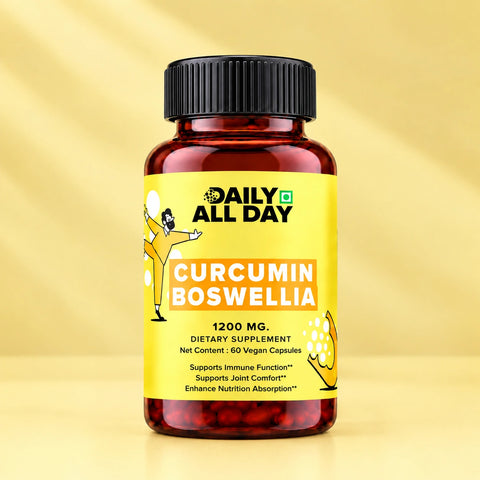
For targeted joint support, our Joint Care formula pairs high-standardized curcumin with boswellia and black pepper extract (piperine) for enhanced absorption. Used together, the two products address plant-based joint pain relief from multiple angles.
On dosing and timing: take both with your largest meal of the day. The fat content in food meaningfully improves curcumin absorption, and the omega oils absorb better with food as well. Splitting the curcumin dose (morning and evening meals) rather than taking it all at once keeps plasma curcuminoid levels more consistent through the day. See our plant-based omega-3 guide for more on how fatty acid timing works.
30/60/90 Day Milestones
By day 30: Most adults using curcumin joint pain relief vegan supplements notice reduced morning stiffness. The first sign is usually how you feel getting out of bed or standing from a desk chair after a long session. Sleep quality sometimes improves around this point, likely because lower-level background discomfort stops interrupting rest.
By day 60: Cumulative anti-inflammatory load starts showing more clearly. Range of motion during exercise or daily activity typically improves. Remote workers often report needing fewer mid-day position changes to stay comfortable. This is also when many people find they can sustain longer movement sessions (walks, yoga, gym) without the next-day payback stiffness.
By day 90: The 90-day mark is where clinical trials tend to show their strongest results for curcumin-boswellia combinations, and personal experience generally matches that pattern. Joint comfort during extended work sessions stabilizes. The goal at this point is maintenance rather than catch-up, which often means you can reassess whether your current dose is still necessary or can be adjusted.
For context on metabolic and recovery timelines more broadly, see our post on building metabolic resilience.
Frequently Asked Questions
Does the form of curcumin (capsule vs. powder vs. phytosome) actually affect how well it works for joint pain?
Yes, significantly. Standard curcumin powder has poor water solubility and low oral bioavailability on its own. Phytosome-bound curcumin and BCM-95 preparations have demonstrated meaningfully higher plasma curcuminoid levels in small clinical studies compared to unformulated powder, even without piperine. For curcumin joint pain relief vegan supplements to deliver their studied effects, the format matters as much as the milligram count.
Are there people who shouldn't take vegan curcumin supplements even if they're plant-based?
Yes. People using blood-thinning medications should consult a healthcare provider first, since curcumin has mild antiplatelet activity that could compound those effects. Individuals with gallbladder conditions (gallstones or bile duct obstruction) should also be cautious, as curcumin stimulates bile flow. Pregnant individuals are typically advised to avoid supplemental doses until more safety data exists for that population.
Does taking curcumin with food really make a difference in absorption?
It does, and this is one of the most consistently overlooked details in supplement guidance. Curcumin is fat-soluble, meaning it needs dietary fat present to be absorbed efficiently through the gut wall. Taking it with a fat-containing meal can meaningfully increase bioavailability compared to taking it fasted. For vegan curcumin for desk job stiffness, pairing your supplement with lunch or dinner, rather than first thing in the morning, is a simple adjustment that improves what your body actually gets from each dose.
How does curcumin compare to omega-3s for joint support, and do I need both?
They work on different parts of the inflammatory process. Curcumin directly inhibits COX-2 and NF-kB pathways; omega-3 fatty acids supply precursors for specialized pro-resolving mediators that actively resolve inflammation once it has started. Using both, as in pairing Joint Care with Total Wellness- Vegan Omega 3 6 9, covers more of the inflammatory pathway than either does alone. Whether you need both depends on severity, but for chronic desk job stiffness the combination is generally more effective.
What dose of curcumin is actually supported by research for joint discomfort?
Most trials that showed meaningful results used 500 mg of standardized curcumin extract twice daily, totaling 1,000 mg per day. A 2016 meta-analysis of 8 trials and 606 patients found this dose range consistently outperformed placebo for joint pain and function outcomes. Higher doses (above 4,000 mg/day) have produced GI side effects in some trial participants without proportionally better results, so more is not better here.
How do joint formulas suitable for vegans differ from standard joint supplements?
Traditional joint supplements often contain glucosamine (from shellfish) and chondroitin (from bovine cartilage), both non-vegan. Plant-based joint formulas substitute these with botanical anti-inflammatories like curcumin and boswellia, which have their own distinct clinical evidence base. The mechanisms differ: glucosamine targets cartilage matrix synthesis while curcumin targets inflammatory signaling, so they're not direct replacements, but the botanical route is fully plant-derived and has substantial trial support of its own.
If your joints have been quietly complaining every time you stand up from your desk, curcumin joint pain relief vegan supplements offer a well-researched, fully plant-based place to start. Pair them with the omega fatty acid support your body needs to actually resolve inflammation, not just block it.
See the full Total Wellness- Vegan Omega 3 6 9 formula